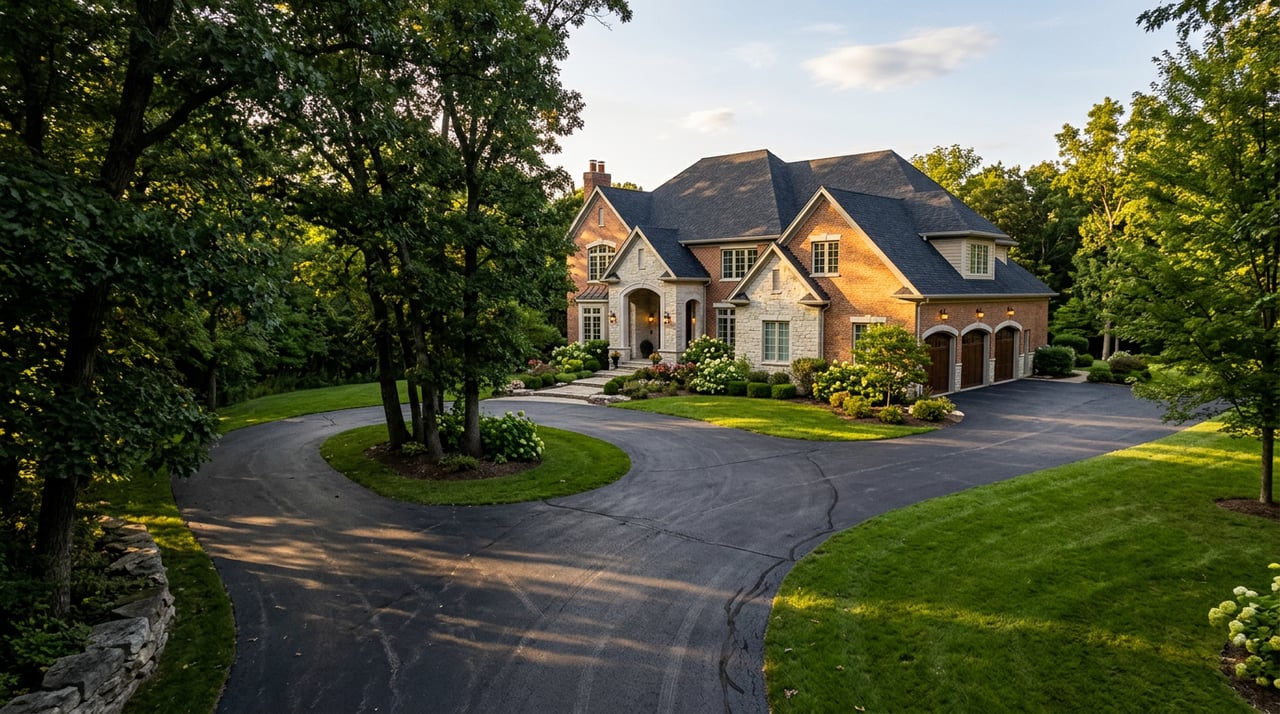
Who owns the road you'd be driving on every day if you bought that five-acre lot on Bateman Road or off Otis Road? It's a question worth settling before closing, including whether any shared responsibilities are documented.
That question is one thread that runs through almost every piece of due diligence unique to buying or selling in Barrington Hills. The village's five-acre zoning is part of its rural character and estate-scale privacy. Understanding what responsibilities apply to properties with private roads, wells, or septic systems, and what the law does and doesn't require anyone to check before you sign, is the difference between a smooth closing and a surprise six months in.
The Village Doesn't Own Your Road
Barrington Hills has 24.5 miles of private roads within its borders, according to the village's own guidance for residents. That's not a typo and not a rounding error. The village publishes advice on when a private road needs resurfacing versus patching, with engineering input from Alex Dye of Trotter & Associates on reading cracks, drainage problems, and vegetation overhang as early warning signs. But publishing advice is different from paying the bill. The village's guidance helps homeowners spot road problems; buyers should verify who is responsible for private-road maintenance.
For a buyer, this changes what "due diligence" means. In a typical suburban subdivision, you'd ask about HOA dues and call it done. In Barrington Hills, the more useful question is narrower and more specific: is there a recorded private road maintenance agreement covering this exact stretch of road, who are the other parties to it, and when was it last invoked. Find out what road arrangements apply before buying, rather than waiting for a call about a $40,000 repaving split four ways.
The Disclosure Form Doesn't Require Anyone to Test Your Water
Illinois sellers complete a standard disclosure report under the Residential Real Property Disclosure Act, and two of the twenty-some statements on that form ask directly about the well and the septic system. That much is consistent across the state and has nothing special to do with Barrington Hills. What's easy to miss, especially for a buyer coming from a part of the country where municipal water is the default, is what the form actually obligates the seller to do before answering.
The statute defines "aware" as actual notice or actual knowledge, without any specific investigation or inquiry. The seller is not required to test the well. Not required to have the septic pumped and inspected before listing. Not required to do anything beyond disclosing what they already happen to know. If the well has run clean for fifteen years and nobody has ever flagged a problem, the seller can honestly check "no" on that line and be exactly right, because nothing in the law asks them to look harder.
That's not a loophole. It's the law working as designed for a state where most residential sales involve municipal utilities and the well/septic questions are the exception, not the rule. But in Barrington Hills, where private wells and septic systems are the norm rather than the exception on estate-scale lots, that exception becomes the main event. The practical takeaway for a buyer is straightforward: the disclosure form tells you what the seller happens to know, not what an inspection would find. If well output, water quality, or septic capacity matters to you, and on a working horse property or hobby farm it usually does, that's a test you order yourself during your inspection period. Nobody else is going to order it for you.
The Trail Map Is Not a Deed
Part of what makes Barrington Hills distinct, even among the affluent northwest suburbs, is the density of bridle trails threading through it. The Riding Club of Barrington Hills documents over 150 miles of trails, a mix of public forest preserve land and private segments.
That mix matters more than it sounds like it should. A property listing might sit two hundred feet from a trail that looks, on a map, like it connects straight to the forest preserve. A buyer drawn to Barrington Hills specifically for the riding culture should treat "trail access" the same way they'd treat a well: something to verify against recorded documents and current club rules, not something to assume from a satellite image.
Why the Village Protects This Anyway
None of this is an accident of neglect. According to Wikipedia, the five-acre minimum lot size in the village's R-1 district has been in effect since 1963, and it has been tested in court. In the 2004 case JLR Investments, Inc. v. Village of Barrington Hills, the courts upheld the five-acre minimum against a proposal for denser development, affirming that the village's low-density zoning was a legitimate exercise of its authority rather than an obstacle to be litigated away.
The ruling affirmed the village's authority to retain its low-density zoning. Barrington Hills spans roughly 27 square miles and has a population of roughly 4,200 people; those figures describe the setting, but don't determine which road, water, and waste responsibilities apply to a specific property. For a buyer, the practical takeaway is to verify those responsibilities before closing.
The most visible recent proof of how seriously the village and its residents take that rural character came in 2022, when Citizens for Conservation acquired Hill 'N Dale Farms, the historic estate once owned by Richard L. Duchossois. The organization's plans include restoring the original contours of Spring Creek along with the surrounding wetlands and prairie. It's the kind of move that only makes sense in a place where land use decisions are still treated as generational, not just transactional.
What to Verify Before You Write an Offer
- Ask whether the road serving the property is covered by a recorded private road maintenance agreement, and if so, who the other parties are and what the cost-sharing formula looks like.
- Order an independent well flow and water quality test during your inspection period rather than relying on the seller's disclosure answers alone.
- Have the septic system inspected and, if it hasn't been pumped recently, pumped and evaluated before closing.
- If trail access matters to your decision, verify it against recorded easements and current club information rather than relying on visual proximity to a trail.
- Review the property's zoning classification if you're planning any accessory structures like a barn or riding arena.
None of these steps are exotic. They're the same categories of due diligence smart buyers already do everywhere. What's different in Barrington Hills is how much weight each one carries, because there's no HOA and no municipal utility system quietly backstopping the outcome if you skip one.
A Few Questions Worth Settling Early
Does every property in Barrington Hills sit on a private road? Not every single one, but private roads make up a substantial share of the village's road network, at 24.5 miles by the village's own count. Ask specifically about the road serving any property you're considering rather than assuming based on the village's general reputation.
If the seller's disclosure says the well and septic are fine, do I still need my own inspection? Yes. The disclosure reflects what the seller actually knows, not what a test would find. An independent inspection during your contingency period is the only way to know the current condition rather than the seller's honest but untested belief.
What should I verify about trail access near a property I'm buying? Confirm the access rules for the specific trails near the property before counting on that access.
Barrington Hills rewards buyers who do their homework and it can be unforgiving to those who skip it. If you're weighing a move here, whether you're drawn to the acreage, the horse culture, or the quiet, Tara Kelleher and her team can walk the specific road agreements, well history, and trail rights tied to any property you're considering, and help sellers get ahead of these questions before a buyer ever asks them. Get your home valuation and staging plan started today.
This article is general information, not legal, tax or financial advice. Consult a qualified professional about your situation.